What is a customer worth to you?
Enter your average order value, margin and how often customers order. Add how long they stay, or your yearly retention. See lifetime value in revenue and margin, how it compares with what a new customer costs, and what better retention adds.
- 2 routes
- Every sum shown
- No sign-up
Your orders, over a lifetime.
Type your own numbers. The results and the sums below them update as you go.
Your numbers
Filled in with an example: orders of €40 at a 45% margin, twice a year, for 2 years, and €35 to win a customer. Replace it with your own numbers.
Revenue per order. Use amounts without VAT, like your margin.
Revenue minus product cost, as a share of revenue.
How often a customer orders in a year while they’re still buying from you.
How long a customer keeps ordering, on average. Keep it below the age of your store.
Share of this year’s customers who order again next year.
Ads and first-order discounts per first-time buyer. Leave empty to skip.
Your real numbers instead of guesses: get them from the order analyzer →
- Lifetime value in revenue
- €160
- Orders over a lifetime
- 4
- Years as a customer
- 2
- Margin per year
- €36.00
In margin, a customer brings in 2.1 times what it cost to win them.
At €3.00 of margin a month, the cost of winning a customer is earned back after 11.7 months.
Add your cost per new customer to see the CLV:CAC ratio and the payback time.
A ratio of 3:1 is a rule of thumb you’ll see often. Use it as a starting point: your own margin and cash flow decide what works for you.
| Scenario | Yearly retention | Years | CLV in margin | Change |
|---|---|---|---|---|
| Now | 50% | 2 | €72.00 | |
| +5 points | 55% | 2.2 | €80.00 | +€8.00 |
| +10 points | 60% | 2.5 | €90.00 | +€18.00 |
Your 2 years match a yearly retention of 50%: 1 − 1 ÷ 2. The table uses that as its starting point.
Above 95% yearly retention there’s no result: customers would stay 20 years or more.
What does a higher second order rate add in the first year? Use the retention calculator →
- margin per order
- = €40.00 × 45% = €18.00
- margin per year
- = €18.00 × 2 = €36.00
- years as a customer
- = 2, as you entered
- orders over a lifetime
- = 2 × 2 = 4
- lifetime value in revenue
- = €40.00 × 4 = €160
- lifetime value in margin
- = €36.00 × 2 = €72.00
- CLV:CAC
- = €72.00 ÷ €35.00 = 2.1:1
- payback time
- = €35.00 ÷ (€36.00 ÷ 12) = 11.7 months
A simplified model with your inputs. It predicts nothing: check the outcome against a real cohort of customers.
See what your messages bring back.
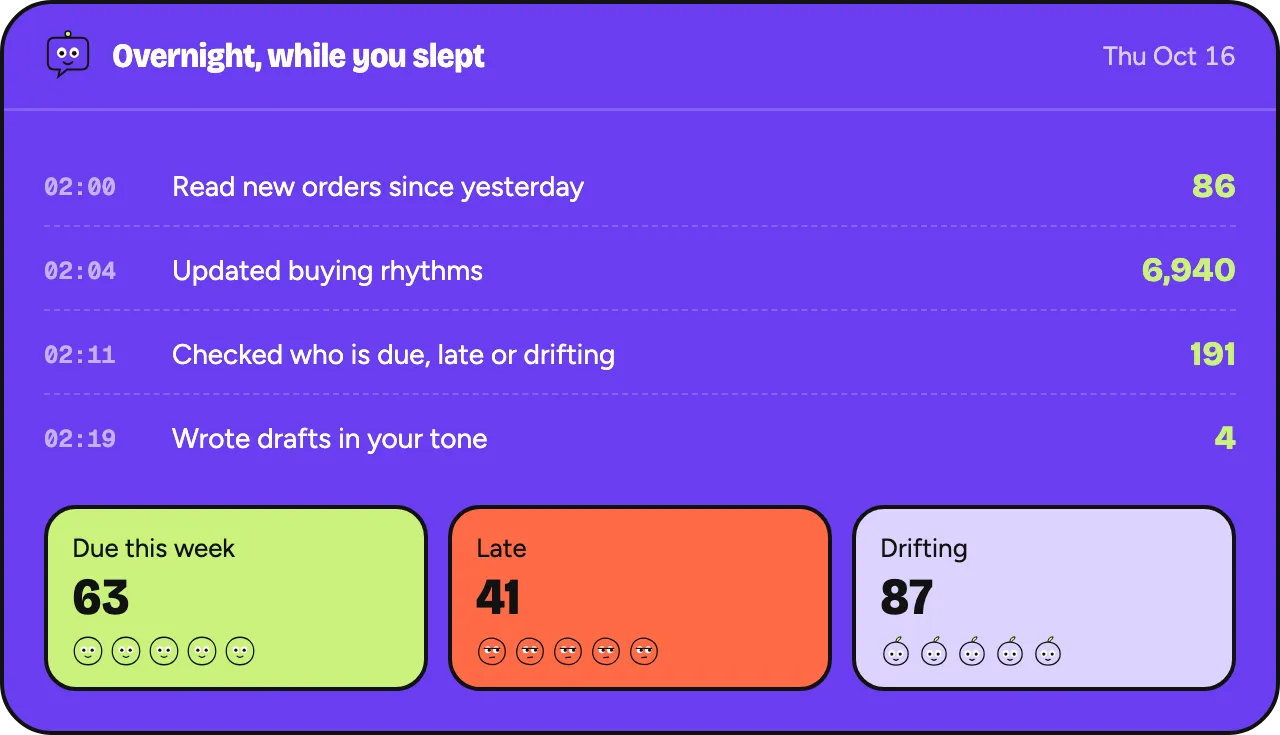
Oftenflow is an AI agent for Shopify stores, still in development. It learns when each customer is likely to reorder and proposes a reminder at that moment.
Its Monday email shows who came back after messages you approved, next to what it cost, measured against customers who got nothing.
How the weekly digest works →Planned: 30% off for the first 100 stores. One email when your invite is ready, no newsletter.
Two routes, one sum.
Lifetime value is what a customer brings in over their whole time with your store. The calculator multiplies what a customer spends in a year by the years they stay, and gives the answer in revenue and in margin. You pick how to say how long they stay.
- lifetime value, years route
- = order value × orders per year × years as a customer
- lifetime value, retention route
- = order value × orders per year ÷ (1 − yearly retention)
- lifetime value in margin
- = lifetime value × gross margin
- years from retention
- = 1 ÷ (1 − yearly retention)
- CLV:CAC
- = lifetime value in margin ÷ cost per new customer
- payback time in months
- = cost per new customer ÷ (margin per year ÷ 12)
- what if
- = the retention route with yearly retention 5 or 10 points higher
In plain language
- Take an order of €40 at a 45% margin: €18 of margin per order.
- A customer who orders twice a year brings in €36 of margin a year.
- Years route: if customers stay 2 years, lifetime value is €36 × 2 = €72 in margin, or €160 in revenue.
- Retention route: every customer has a first year. If half of them order again the next year, and half of those the year after, the years add up to 1 + 0.5 + 0.25 + … = 1 ÷ (1 − 0.5) = 2. Same answer: €72.
- With €35 to win a customer, the ratio is €72 ÷ €35 = 2.1:1. Payback takes €35 ÷ (€36 ÷ 12) = 11.7 months.
- At 55% retention, customers stay 1 ÷ 0.45 = 2.2 years and lifetime value rises to €80 in margin.
What this leaves out
- Discounting. Margin in year three counts the same as margin today.
- Change over time. Order value, margin and orders per year stay the same every year.
- One retention rate for every year. Your first year and later years can differ, which a cohort table shows.
- Other costs: shipping you pay, payment fees and refunds. Take them off your margin first for a stricter number.
- Timing. Payback assumes margin comes in evenly over the year. A first order with a large margin pays back sooner.
- Differences between customers and channels. One average hides them; the RFM tool shows how your customers spread out.
Questions about lifetime value
What is customer lifetime value?
The revenue or margin a customer brings in over their whole time with your store. This calculator gives both. Margin is the number to compare with what it costs to win or keep a customer.
Should I use years or yearly retention?
Use the one you can measure. If a cohort table gives you your yearly retention, use that route. If you only have a rough idea of how long customers stay, use years, and keep it below the age of your store. Both routes give the same answer when retention is 1 − 1 ÷ years.
What is a good CLV:CAC ratio?
You’ll often see 3:1: three times the cost of winning a customer, earned back in margin. It’s a rule of thumb. What works for you depends on your margin, your cash flow and how long you can wait for payback. Below 1:1, every new customer loses money over their lifetime.
Where do I find my own numbers?
Drop your Shopify orders export in our order analyzer. It shows your average order value, orders per customer and revenue per customer so far, from your own orders. Your gross margin comes from your bookkeeping.
Why use margin instead of revenue?
A customer who spends €300 on products with a 35% margin leaves you €105 before marketing. That €105 is what you can spend to win or keep them. Revenue alone would make that customer look nearly three times as valuable.
Get an invite when we open the doors.
Planned: 30% off for the first 100 stores. One email when your invite is ready, no newsletter.
- Plans from €29 a month, never per contact
- Works with the email tool you already use
- No card, no commitment